Human-Centered Design in AI-Based Systems
What if your AI product works perfectly—and people still don't want to use it? Building technology around people's needs, not forcing people to adapt to algorithms.
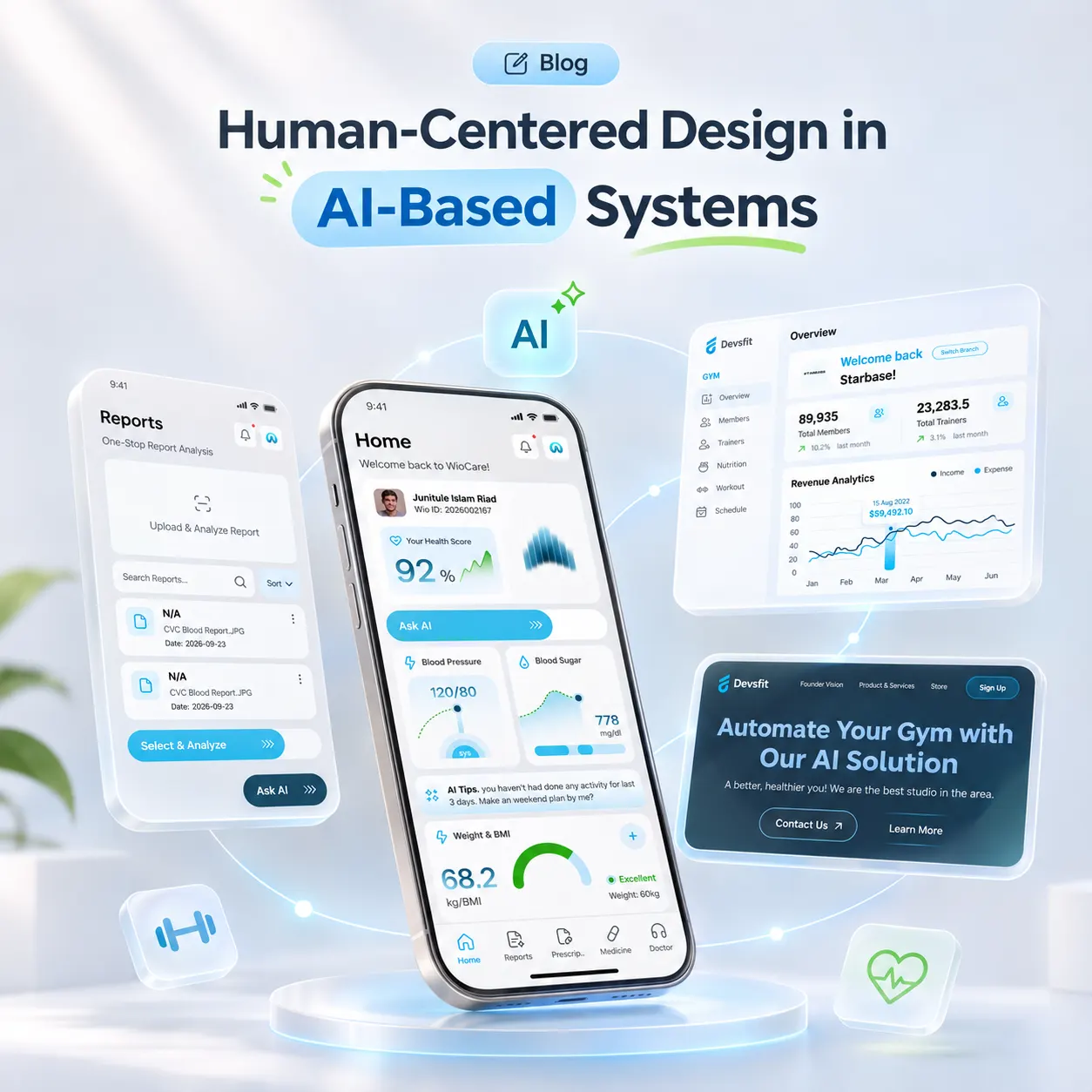
What if your AI product works perfectly—and people still don't want to use it?
It responds in seconds. Its dashboard looks futuristic. Yet a customer leaves because the result makes no sense. A student trusts a wrong answer. A business owner worries about their data.
The technology might be impressive. The experience isn't.
That's the challenge of human-centered design in AI-based systems: building technology around people's needs, not forcing people to adapt to algorithms.
Smart isn't the same as useful
Imagine an AI assistant helping someone book a doctor's appointment. It recommends a time and confidently displays “Confirmed.” Sounds convenient, right?
But the patient didn't notice it chose another clinic, and “Confirmed” really meant “Request sent.” Speed becomes confusion.
Good AI UX design asks questions beyond “Can the system do this?” It asks, “Will someone understand what happened? Can they change it? What happens when the AI gets it wrong?”
Trust comes from helping people feel informed and in control.
The human needs a seat at the table
AI makes things look simple: a prompt goes in, an answer comes out. Hidden in between are assumptions and uncertainty.
Human-centered AI design makes those hidden moments easier to understand. It marks suggestions as suggestions, lets people review actions, and explains limitations without jargon.
And it doesn't punish someone for saying, “No, that's not what I meant.”
If an AI rewrites your email in a tone you'd never use, editing and undoing matter as much as the rewrite. The goal isn't AI taking over the task. It's AI helping you do the task better.
Five small decisions that change everything
Start with the problem, not the prompt. Before adding a chatbot or AI button, talk to users. What frustrates them? Where do they need reassurance? Sometimes the best solution is a simpler form, not a smarter model.
Make the system's role clear. Explain when AI is involved, what it's doing, and where its confidence ends. “Here's a draft you can review” feels more honest than “Here's the perfect answer.”
Keep a human in control. Let users edit, reject, retry, and undo whenever possible. For important decisions—money, education, health, hiring—build sensible review steps and access to human help. Automation should reduce effort, not remove agency.
Design for different people. People have different languages, internet speeds, and digital skills. Clear labels, accessible interfaces, readable text, and forgiving errors matter. An AI feature that only works for power users isn't really user-friendly.
Protect trust before asking for it. Explain what information is collected, why it's needed, and how people can manage it. Avoid requesting unnecessary personal data. One surprising use of private information can undo months of good product design.
None of these ideas require flashy animations. They require attention. And they make technology more welcoming to people trying AI for the first time.
Here's what founders often miss
Founders often track accuracy, speed, and shipped features. Useful metrics, but only part of the story.
Can a first-time visitor finish the task? Do people notice mistakes before those mistakes cause trouble? Do they come back because the product genuinely helps—or because they have no alternative?
Try this: ask someone new to complete one key task in your product. Don't guide them. Watch where they hesitate, misunderstand, or lose trust.
You might discover that a two-word label creates more value than a new AI feature.
And what about students, teachers, and designers?
For students, learn more than AI-generated interfaces. Interview people, map journeys, question outputs, and test assumptions.
For teachers, an AI learning tool should support understanding, not simply deliver instant answers. Let learners see why a suggestion was made, challenge it, and find their own reasoning.
For designers and builders, the opportunity is bigger than choosing colors or writing prompts. It's shaping the relationship between humans and intelligent systems—deciding when to automate, when to explain, and when to step aside.
The best AI experience doesn't make people feel smaller
The future of AI product design won't be won by whoever adds the most intelligence to a screen. It'll be shaped by teams that turn intelligence into something understandable, respectful, and genuinely helpful.
Because behind every click is a person, not a data point.
A Quick Note from the Author
I’m Junitule Islam Riad, Managing Director and Web & Product Designer. I spend my days collaborating with founders, creators, and ambitious teams to design human-first digital products. If you're exploring how to balance advanced tech architecture with clean, empathetic product design, I’d love to connect. You can also dive into design breakdowns and product tutorials over on my YouTube channel.
The future of technology isn't about replacing human judgment with machines. It’s about designing systems that elevate what humans can achieve together.
Let’s talk! What is the most frustrating AI interface experience you've encountered lately, and how would you fix it? Drop a comment below. I read and reply to every single message.
By Junitule Islam Riad — Managing Director & Web & Product Designer.
Watch on YouTube