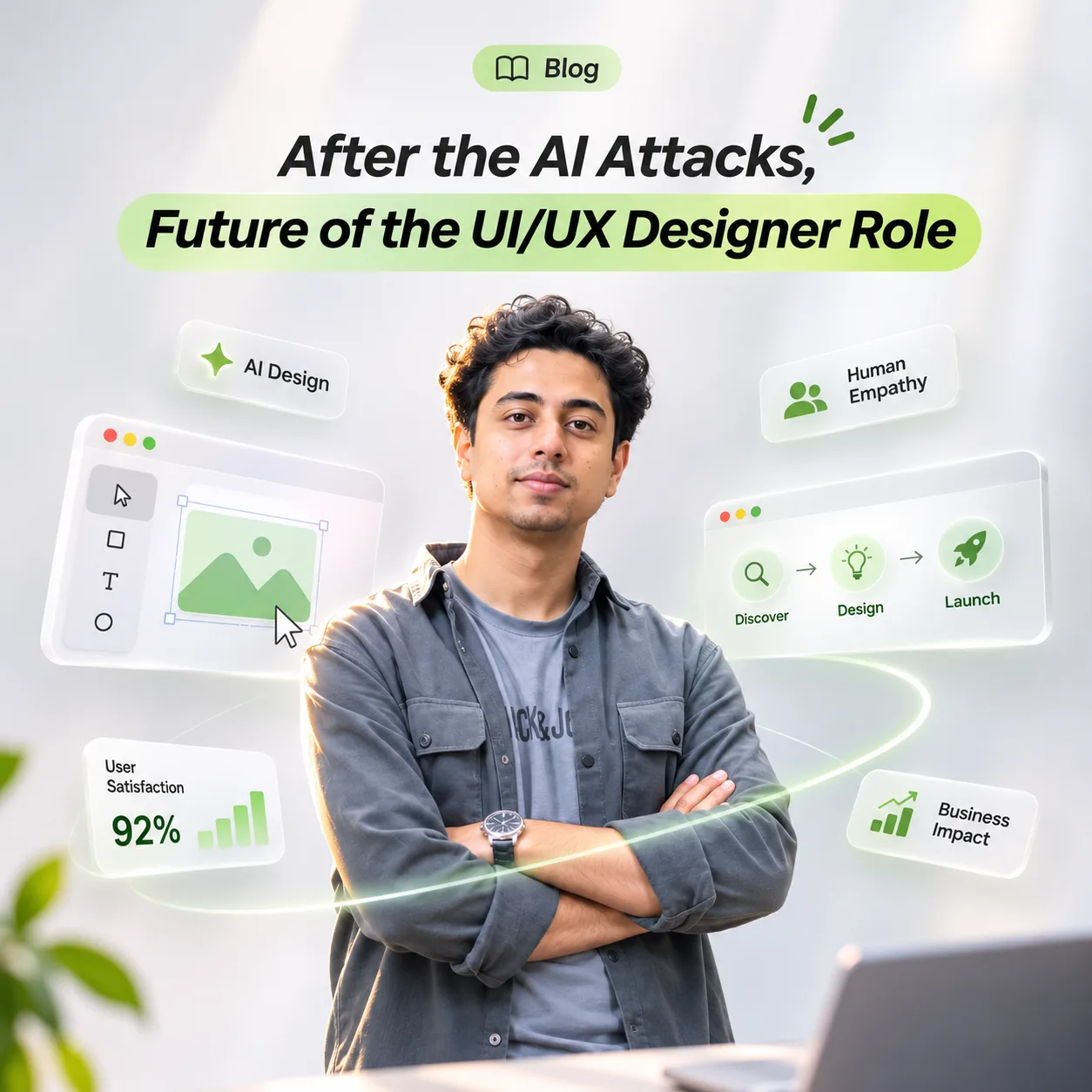
After the AI attacks, Future of the UI & UX Designer Role
If AI can design a screen in seconds, why would anyone hire a UI & UX designer? Because a screen is not the same thing as an experience.
A few years ago, building a website meant hours of wireframes and endless debates over the perfect button. Today, you can type a sentence into an AI tool and watch an interface appear before your coffee gets cold.
So here’s the uncomfortable question: If AI can design a screen in seconds, why would anyone hire a UI & UX designer?
Because a screen is not the same thing as an experience. And that difference is where the future begins.
AI can make the interface. Can it understand the human?
Imagine a student applying for a scholarship at midnight. The deadline is close, their internet is slow, and one confusing form could cost them an opportunity. AI might produce a beautiful application page. But will it know which instructions create panic, which field needs reassurance, or why a “Save and continue later” button matters more than a fancy animation?
A good UX designer asks those questions—and tests the answers with real people.
This is the shift shaping the future of UI & UX design. AI design tools can generate layouts, visual styles, copy, and quick prototypes. But human-centered design still needs empathy, research, and judgment. A dashboard nobody understands is still a bad dashboard.
The old job is changing. The real job is getting bigger.
AI will change design careers. Repetitive tasks will take minutes instead of days. Basic mockups, component variations, and user flows are easier to produce. Designers who only move pixels may feel the pressure.
But faster production creates a surprising new problem: When everyone can generate ten designs, who knows which one is right?
That’s where a UI & UX designer becomes less of a screen-maker and more of a problem-solver. Instead of “Does it look modern?” ask: “Can a first-time visitor understand it? Can everyone use it? Does it help customers choose confidently? Does it support the business?”
For founders, your product can look polished and still lose customers. A checkout hiding delivery fees, an exhausting sign-up form, or a confusing booking page can hurt growth. Better UX isn’t decoration. It removes friction between a person and their goal.
Think with AI. Don't surrender your thinking to it.
The best designers won’t ignore AI or worship it. They’ll use it thoughtfully to brainstorm, summarize research notes, and speed up experiments. That leaves more time to interview users, question assumptions, test accessibility, and collaborate with developers.
But AI output is a starting point, not proof. It can sound convincing while missing a critical edge case. It can copy familiar patterns without understanding local habits, language, trust, or emotion. A design generated for a trendy tech startup may fail completely for a small retailer, a school portal, or a healthcare appointment system.
The advantage is no longer just knowing a design tool. It’s knowing what to ask, challenge, test, and leave out. Sometimes the best design decision is removing a feature.
For students and new designers, that should feel like an invitation, not a warning. Learn visual hierarchy, typography, interaction design, UX research, accessibility, and product thinking. Learn how to explain your decisions, not just showcase your screens. Build something small, watch five people use it, and notice where they hesitate. That lesson may teach you more than another perfect portfolio mockup.
For teachers and mentors, don’t judge only the final visual. Ask learners to show the problem, trade-offs, evidence, and changes made after feedback. In an AI-powered world, the design process matters more than ever.
And for business owners? Don’t ask only, “How fast can we build it?” Ask, “Whose problem are we solving, and how will we know it works?” A fast launch helps. A product people trust and return to matters more.
The future belongs to designers who care about outcomes.
Picture two designers presenting the same beautiful app. One says, “Here are the screens I made.” The other says, “Here’s where users were getting stuck, what we changed, and what we learned.” Which one would you trust with your product?
That’s the future of the UI & UX designer role: not competing with AI at generating pixels, but combining AI’s speed with human curiosity, responsibility, and insight. The designer of tomorrow will be part researcher, part storyteller, part systems thinker, and always an advocate for the person on the other side of the screen.
AI isn’t the end of design. It’s the end of treating design as just making things look good.
A Quick Note from the Author
I’m Junitule Islam Riad, Managing Director and Web & Product Designer. I spend my days collaborating with founders, creators, and ambitious teams to design human-first digital products. If you're exploring how to balance advanced tech architecture with clean, empathetic product design, I’d love to connect. You can also dive into design breakdowns and product tutorials over on my YouTube channel.
The future of technology isn't about replacing human judgment with machines. It’s about designing systems that elevate what humans can achieve together.
Let’s talk! What is the most frustrating AI interface experience you've encountered lately, and how would you fix it? Reach out anytime—I read and reply to every single message.
Written by Junitule Islam Riad — Managing Director & Web & Product Designer.
Watch on YouTube